


Abstract-
Over 80 lakhs cases of corona have been recorded and to prevent it from spreading further, the government had ordered to avoid mass gathering at a place as much as possible. In the current time of the pandemic, the supreme judiciary of India (i.e. Supreme Court) had taken the decision to resume their work online and hearing of pending cases through video conferencing. The court had been adopting new techniques to provide speedy justice to the victims. This article is going to describe that the present action was taken by Supreme Court, of converting physical courts into virtual courts, had also been benefitted the litigants by reducing their travelling cost, it had reduced workload of the courts and now the courts can flexibly work 24*7. But altogether, it had certain challenges as well. At last, it is mentioned that virtual courts are our future and will bring certain changes which are required for supporting our country to develop faster.
Introduction-
As we all know, that, today the whole world has been suffering from the novel Corona Virus attack. In this adverse situation, social distancing has become most important to avoid the spread of coronavirus. This had not just affected human life but also the economy of the country. As the recovery rate has been improving, people are returning to their work (but maintaining full precautions). In this condition, courts are also resuming to their work via online mode. This pandemic had forced Indian judiciary to adopt technological ways to continue their work of delivering justice. Even if we see then most of the works are being virtual like teaching, banking, etc.
Currently, the Apex Court of India had provided certain guidelines in which they directed the courts at all level, to use the technology-oriented methods (i.e. video-conferencing) to hear the judicial proceedings so that justice could be given without any further delay. The Corona pandemic had made judiciary to make an effort towards the adoption of the advanced method of working. Now, the courts working are virtual and litigations and hearing proceedings are done through video conferencing call. This had given an idea to set up virtual courts which could be proved to be a great support. This could definitely help in reducing various lacknesses which we have to face in physical courts.
What are Virtual Courts-
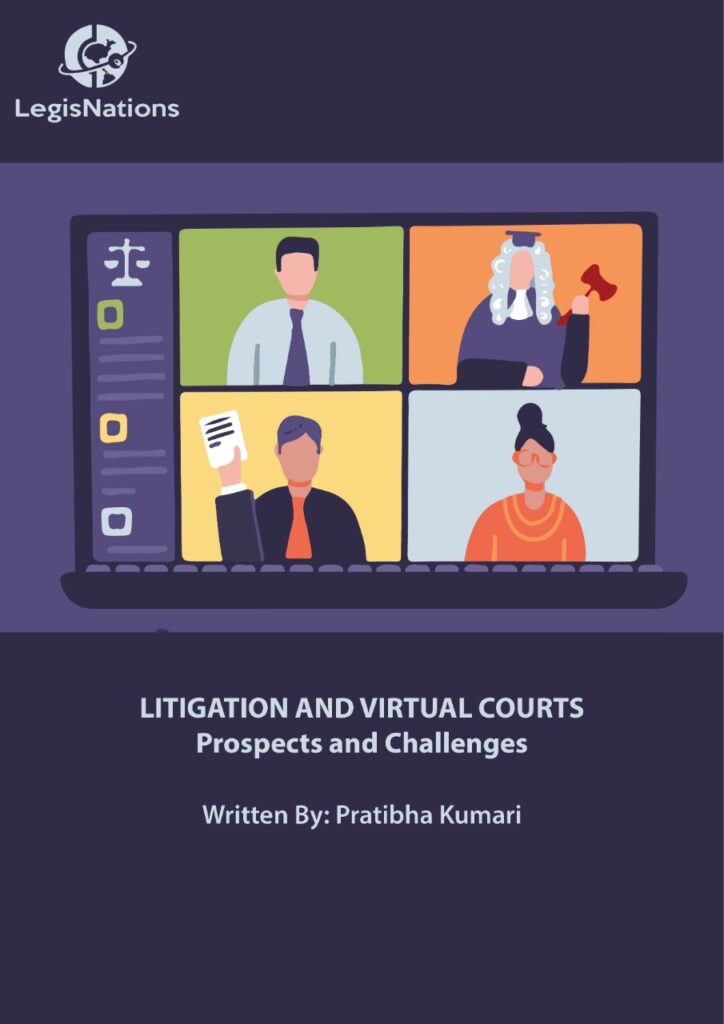
In simple words, virtual courts are those courts which “online courts.” In Virtual Courts, there is no need for physical presence and all the procedures are done through online mode, using the technological method. It allows remote working. The purpose of these types of online courts is to reduce the physical movement and makes adjudication of case possible through internet mechanism. It requires applications and software tools to conduct virtual court proceedings. Virtual courts will be helpful in computerizing the whole legal system.
Prospects of Virtual courts and Litigation-
Indian judiciary is being transformed and adopting virtual and other technological methods for effective working. The e-courts project laid down through the guidelines given by Supreme Court of India under which on 26th July 2019 NCR’s first virtual court begun at Tis Hazari district court. Afterwards, Punjab and Haryana High Court have taken initiative to conduct virtual court in Faridabad district, dealing in with traffic and challan cases, in Haryana. This had resulted in reducing the number of litigants to courts. Even eminent judge of Supreme Court J. D.Y. Chandrachud, while interacting with the chairpersons of e- committees formed of different High Courts, gave the direction that this advance system could be used even to adjudicate other types of cases too.
The government has taken steps to digitalize the judiciary. On 26th November, 2019 (i.e. on Law Day), President Mr Ramnath Kovind had lunched the ‘Supreme Court Vidhik Anuvaad Software’. It is an app which can translate judicial documents which are in English to 9 jargon languages or vice-versa. This will save time and provide easy access to case status, day- to- orders as well as the judgment delivered by the court to parties and advocates. On 15th March, 2020, Chief Justice of India Sharad Arvind Bobde had also affirmed that latest technology should be adopted which would help judicial hierarchy in constructing a plan of action to dispense timely and cost-effective justice to needy litigants. This will ensure the maintenance of social distancing by avoiding any gatherings in the court. His ideology was with the motive that COVID 19 could not affect the functioning of the judiciary. He further supported the necessity for adopting an Artificial Intelligence system with the specific motive of providing effective justice by eliminating unnecessary delay.
Virtual Courts will be supporting in reducing unnecessary burdens on the hierarchical courts. This will ultimately build the confidence among litigants to access justice even if courts are closed (due to the pandemic going on) and ensure speedy justice to all needy ones. Even Karnataka High Court had issued certain guidelines for online filing or registering of cases apart from manual filing and hearing of cases through video conferencing for all the district courts situated within the state.
Benefits of virtual courts and litigations-
Establishing of virtual courts will be a huge transformation in the legal system. It will provide various benefits like the foremost and important benefit of easy access to justice, litigant friendly, online filing of litigation, etc. There are chances of adopting virtual court mechanism in near future. There are certain benefits of adopting the virtual court systems as mentioned below-
- A proper mature mechanism of online courts with adequate application which would help in termination of costs incurred in constructing infrastructure of courts, staffs’ expenses and expenses on security system, etc.
- Litigants are not required to be physically present before court, which will save his or her travel and time expenses.
- It will provide flexibility in working hours of court and judges could easily work 24* 7 also. Even every case will be personally heard by judges.
- It will be more litigants friendly. It provides as much benefits as possible as it is saving his time and travel cost, court expenses, opportunity to file the case online, etc. This will reduce extra burden from the litigant’s shoulders. Moreover, amplification of courts will increase the adjudication rate of litigation.
- Judiciary will become more transparent and thus accountable to the parties which will make the administration system of judiciary work efficient.
- It will make sharing of information easier because all the data stored are in digitized form, available at one place.
Issues and Challenges raised-
There are some probable challenges which could be faced in matter of virtual courts.
- Foremost, the problems can be faced in the applicability and originality of witness’s identity and authenticity of evidences produced before court could be doubtful. In such cases, open trial are better than virtual one.
- Second most adverse effect could be cyber related crimes like hacking and lack of adequate data privacy. There are risks of confidential in court proceedings because data is stored in apps and software who themselves are not much secured. Moreover, one virus attack in computer could corrupt and erase all the data stored.
- There are various complications in process of e- filing of litigations.
- Transforming whole judicial body into virtual system is itself very costly. Implementation of advanced technology and digitizing every subject matter of legal system is itself very expensive. In India, we have more than 500 district courts and total of 24 High Courts and transforming each of them into virtual format will be exorbitant and equivalent time will be consumed.
- The virtual court requires access to and good internet connectivity. Litigants came are not only from rich or middle class, some are even from poor class, who does not have access to internet connection. Virtual Court is not of any use for those who do not how to use internet or computer or (android) mobile.
Recommendations and path forward-
There are some recommendatory steps to be taken in mind while setting up of virtual courts for its effective working. These are as follows-
- There should be adequate legislations formed which would deal with, virtual courts related issues like data privacy, accountability, prevention of delays, etc.
- Classification of cases should be taking their nature and time for disposal as the basis. Not all the cases should be made to solve through online mode but only those which require less argumentation and mechanical in nature should be adjudicated using online mode.
- The course related to technical skills should be included in training modules in law colleges or universities and National Judicial Academy, so that future legal professionals could use their technological skills in practical life.
Although there are so many challenges in front of government in setting up virtual courts but still following certain remedial measures, virtual courts could prove to be helpful in delivering effective justice. For this, the government to formulate effective policy and ameliorate the current infrastructure of courts. The most common point which the framers should keep in mind is that virtual court and litigation system should be made user- friendly as well as fully secured from any kind of cyber crimes. Otherwise, the main motive of establishing virtual court would remain unfulfilled. Virtual court and litigation had a good scope in near future and if the abovementioned challenges could be removed, then it will prove to be very effective justice delivering mechanism.
Conclusion-
Today, we are all victims of COVID- 19 and this challenging situation had made us realized that it is very essential to re- shape the contemporary litigation and court system. The realization has been made regarding the adoption of new and advanced technologies in the legal system. As our society is being moving forward to the digitized era, there is a requirement to make the court system fully digitalized which will in return gain various advantages for the participants. The establishment of virtual court and litigation would eliminate all the difficulties faced in physical courts. But for this, firstly the legal society should set up a mind set to do so and should have consensus of all that such a transformation would be beneficial in dispensing speedy remedy to needy people.
Till now, we have seen the adverse effects of COVID- 19 but the crisis has brought on this wonderful opportunity to develop our legal system to an advanced level which will ultimately help in upgrading the welfare of society. The only need is that to focus on the problems that are in way of setting up of virtual courts and solve them which could definitely in forming a full-fledged effective virtual court and litigation system in India.