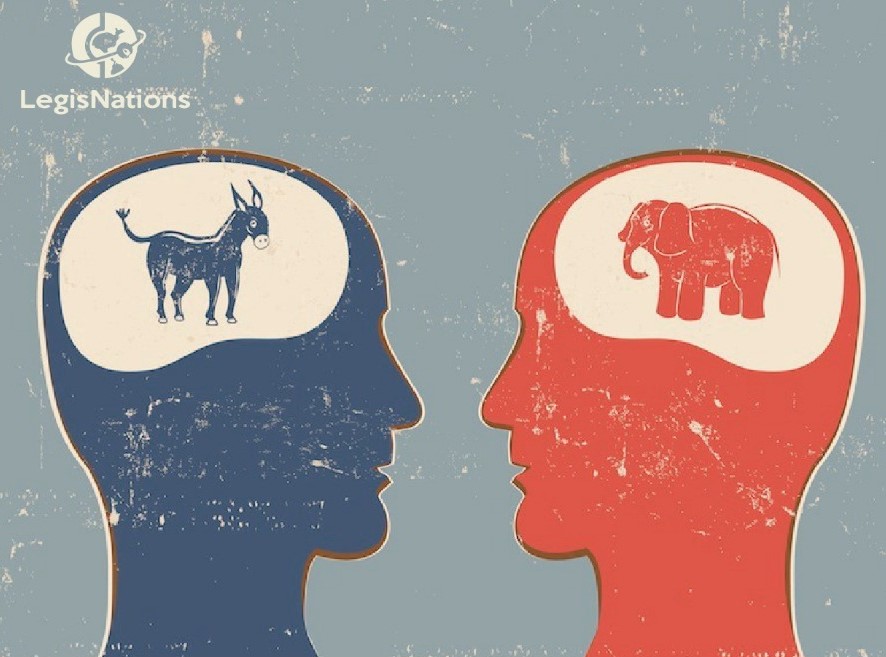
Today’s politics is all about the optics – who presents their opinion in the most appealing manner, who attracts the most attention in the news or online, and who can inspire the common folk. Within all of this political chaos, one often finds people throwing around words like ‘right-wing’ and ‘left-wing’. However, how many of us truly know the meaning of these terms and their origin? To understand the dichotomy of left-right politics, it is essential to understand what political ideology is.
While there is considerable debate on the precise definition of the term ‘ideology’, with scholars often disagreeing on the fundamental elements, Terry Eagleton, the famous British literary theorist, defines the term in a very well-rounded manner in his book Ideology: An Introduction (1991): “Ideology is a system of concepts and views which serves to make sense of the world while obscuring the social interests that are expressed therein, and by its completeness and relative internal consistency tends to form a closed system and maintain itself in the face of contradictory or inconsistent experience.”[1] Ideology, in sociological terms, is essentially a way a dominant group or class legitimises their power through their beliefs and ideas. Political ideology, in an oversimplified manner, is an ideology with respect to the polity and governance of a country. Political ideologies or political positions (often used interchangeably) have interested political scientists for ages. In an attempt to compare, classify and characterise political ideologies, one of the methods political scientists use to study political ideologies is called the political spectrum. A political spectrum is a method which lets us place various ideologies in a geometric axis and assign a particular dimension to one ideology with respect to the others. This helps us visualise a set of ideas in a comparative manner. One of the most widely used spectra is the left-right political spectrum. To understand this spectrum, it is essential to discuss its origin and fundamental concepts.
The left-right political spectrum originates from the French Revolution. In the first meeting of the Estates-General in 1789, those who supported the revolution sat to the left of the President of the National Assembly, and those who supported the Monarch, that is, the Aristocrats, sat to the right of the President[2]. In the most basic sense, this divide initially demonstrated the clear divide between revolution and reaction. Since then, “the terms have subsequently been used to highlight a divide that supposedly runs throughout the world of political thought and action, helping both to provide insight into the nature of particular ideologies and to uncover relationships between political ideologies more generally.”[3] In the left-right political spectrum, the terms ‘left’ and ‘right’ indicate the polar extremes of the spectrum, and one’s own political ideology may fall anywhere within this spectrum. ‘Left’ and ‘Right’ being the extremes of this spectrum, a large number of people find themselves somewhere in the centre (albeit leaning to either one side). Historically, ‘left-wing’ has always been associated with revolution and promoting change, while ‘right-wing’ has been associated with resisting change and maintaining the status quo. This left-right spectrum, apart from depicting polar political positions, can also be looked at from the perspective of economic policy. Those who support the left-wing would ideally support collectivism, trade unionism and intervention, while those who support the right-wing ideally stand for individualism and a free market. Another interesting perspective to this is by Norberto Bobbio, who in his book ‘Left and Right: The Significance of a Political Distinction’ opines that the fundamental distinction between the political left and right is their ultimate intention: the left stands for equality, while the right believes that attaining equality is not desirable or possible, and hence advocate for hierarchy.[4] In modern times, we see that various groups have been associated with either end of the spectrum. Progressives, communists, democrats, liberals, socialists, et cetera have been associated with the left, while conservatives, imperialists, neoconservatives, traditionalists, fascists, et cetera have been associated with the right.
In understanding how politics works, it is essential to simultaneously understand that the left-right political spectrum is not a rigid concept, or universally accommodating. In fact, visualising political positions in this unidimensional form is often considered rather problematic. This kind of linear spectrum has a range of impediments, as discussed by Andrew Heywood in his book, Political Ideologies: An Introduction. Firstly, it is cardinal to understand that every ideology is structured in a way that there exist certain contradictory and disagreeable elements. Locating such ideologies precisely in a linear spectrum can be extremely precarious. Heywood gives the example of Anarchism, which even though is often associated with the left, can also exist in theory as an “ultra-right-wing” political position, as “it encompasses both anarcho-communist and anarcho-capitalist tendencies”[5]. Secondly, it has been observed that ideologies often manifest themselves differently in different parts of the world. This makes it inexpedient to assign decisive positions to ideologies within the left-right spectrum. For example, in most parts of the world, liberalism is associated with the left. In Europe, however, liberalism is often associated with those who support the free market and individualism, while conservativism is linked to the Christian democracy, that advocated for social intervention[6]. Thirdly, owing to the fact that all of us are individuals capable of learning and processing new information, the political positions we hold are not static. The concept of ideologies is fluid: we often find ourselves changing our opinions with the absorption of new information, and this may lead to a change in political views. Not only our perception and agreement with an ideology, but ideologies themselves often change and reinvent themselves with the changing times. This makes it essential to keep updating our perceptions of what constitutes the left and what constitutes the right. Finally, with the changing times, the advent of technology, and the world operating at an ever-increasing pace, ideologies as well as discourse on ideologies has amplified. This has led to ideologies and their surrounding debate to become even more complex. However, we notice that the left-right spectrum in itself has become more and more simple with time, with two extreme ends conveniently assigned a type of ideology. This does not allow us to accommodate more convoluted political interactions on this spectrum. The left-right spectrum has been criticised for not being able to accommodate some significant contemporary political movements like feminism, regionalism, abolitionism, pacifism, among many others. All of these criticisms have led to the development of a two-dimensional political spectrum, which uses the left-right linear spectrum in an economic sense and adds the social concepts of ‘liberty’ and ‘authority’ as the two polar ends of the vertical axis[7]. This two-dimensional spectrum is often popularly known as the ‘Political Compass’. It has, however, received its fair share of criticism for being yet again too restrictive and redundant in depicting political ideologies.
Let us take the example of Indian politics. As of today, India has eight national parties, over fifty state parties, and thousands of unrecognised registered parties[8]. While talking about national politics, we often hear political pundits on the news assigning a part the title of ‘right-wing’ or ‘left-wing’. However, a close analysis would show that not every party can be distinctly pinpointed as far-right or far-left. In India, most of the parties are either centre, right-leaning, or left-leaning parties. It might be easy to draw a line to connect the Bharatiya Janta Party (BJP) to the right-wing and the Communist Party of India (Marxist) (CPI(M)) to the left-wing. However, none of these parties are radically right or left-winged while addressing every issue. The stance of every party on the political spectrum varies from issue to issue. Let us take the example of the Indian National Congress (INC), the party that has enjoyed parliamentary power for the longest time in the 73 years of Indian polity. Initially, in the rudimentary years of the country’s political and economic history, under the leadership of Jawaharlal Nehru, the markets in India were considerably closed-off and tight, and an attempt to implement socialist ideas was made. However, it is the same party, with P. V. Narsimha Rao at the helm, that later on implemented India’s ‘New Economic Policy’ in 1991, opening the doors of our economy to global markets. It incorporated the ideas of Liberalisation, Globalisation and Privatisation in our economic model. These two decisions, albeit years apart, represent the party leaning to different ends of the political spectrum. Similarly, stating that the BJP has never put forth a scheme for social security and welfare is also not true. These examples make it extremely clear as to why assigning one specific location on the left-right spectrum to every political party is not only restrictive and challenging but often incorrect.
In a world that is becoming more complex by the passing minute, what we need is political discourse. Not just any discourse: mere interaction is not enough. Discussion, deliberation, debate, information processing and learning are essential to keep ourselves updated on the day-to-day happenings and forming well-informed opinions. Restricting our stance on a particular issue just because we choose to identify ourselves with one end of the spectrum does more harm than good. As discussed earlier, it is possible, and in fact in the best of our interest to take a stance on what we believe is true and beneficial for society, not just blindly taking a stance based on where we usually identify ourselves as on the political spectrum. While the left-right political spectrum has helped us simplify and compare political ideologies, it is cardinal to acknowledge that it often criminally oversimplifies political interaction, which in its true sense, is incredibly intricate. We must ensure that we use this spectrum only to attain a grasp of the basic concepts of politics, and not solidify our positions based on it. It is, after all, a static, constrictive intellectual construct incapable of accommodating today’s ever-dynamic political atmosphere.
[1] Terry Eagleton, Ideology: An Introduction (1991).
[2] Andrew Heywood, Political Ideologies: An Introduction 86 (6 ed. 2017).
[3] Id.
[4] Norberto Bobbio, Left And Right: The Significance of a Political Distinction (1996).
[5] Heywood, supra note 2 at 89.
[6] Heywood, supra note 2 at 91.
[7] Heywood, supra note 2 at 93.
[8] Election Commission of India, List of Political Parties & Symbol MAIN Notification (2019), https://eci.gov.in/files/file/9438-list-of-political-parties-symbol-main-notification-dated-15032019/ (last visited Jul 3, 2020).